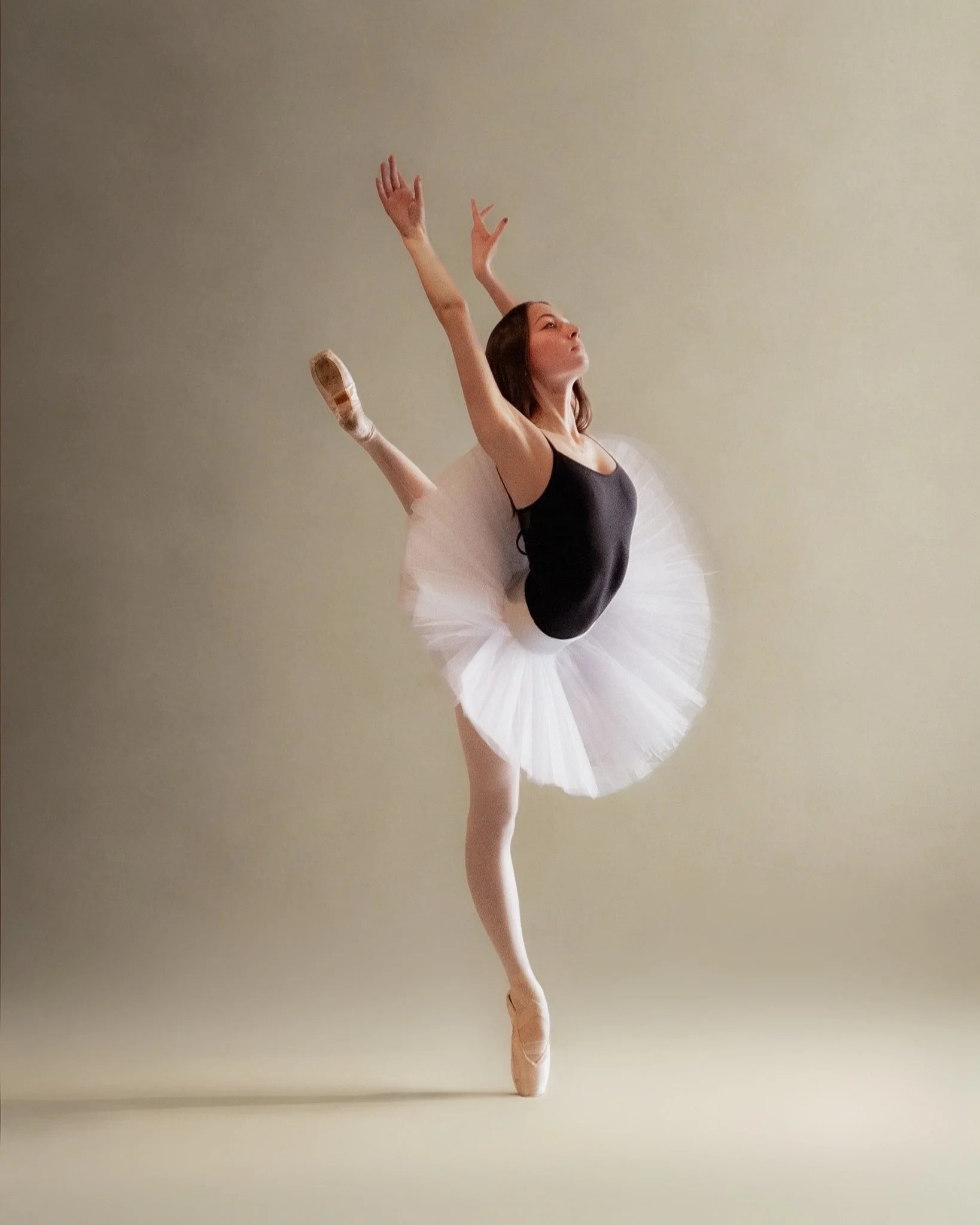
Serious & Pre-Professional Ballet Training in Kalamazoo
A clear path from Ballet I through Advanced.
Tye Chua Dance offers progressive classical ballet training for dancers who want to grow with purpose. Our leveled program combines thoughtful placement, clear technical progression, individualized instruction, musicality, artistry, and increasing challenge—giving each dancer a strong foundation and a pathway toward advanced and pre-professional study.
A Progressive Path to Advanced & Pre-Professional Ballet.
Ballet develops through layers. From Ballet I through Advanced, each level introduces new material while deepening the strength, coordination, musical understanding, vocabulary, discipline, and technical clarity established in the levels before it.
Establish the Foundations
Early leveled ballet develops posture, alignment, coordination, musicality, classical ballet terminology, classroom focus, and an understanding of how barre and center work are organized. Dancers learn not simply what steps are called, but how ballet technique is built.
Build Strength & Consistency
As training progresses, dancers work with greater precision, stronger placement, increased coordination, more complex combinations, and growing responsibility for understanding and applying corrections. Repetition develops reliable technique rather than simply familiarity with steps.
Prepare for Greater Demands
As dancers move into more demanding levels, training develops endurance, technical maturity, artistry, performance awareness, increasingly complex vocabulary and combinations, and the ability to retain and execute detailed material. When developmentally appropriate, training also begins to support pointe readiness.
Refine Technique & Artistry
Advanced dancers work toward technical clarity, stamina, versatility, sophisticated musical interpretation, mature artistry, personal responsibility, and professional-level attention to detail. For dancers pursuing intensive training, this work provides the foundation for pre-professional, residential, collegiate, and professional pathways.
Placement Is Based on Readiness—Not Just Age
Dancers advance when they have developed the strength, understanding, consistency, physical readiness, maturity, and technical foundation needed for the next level. Spending additional time strengthening those foundations is not falling behind—it is an important part of safe, serious ballet training.
Explore the Ballet Levels.
Each level has a distinct purpose within Tye Chua Dance’s progressive classical ballet curriculum. Age offers a useful starting point, while placement also considers previous training, technical development, strength, maturity, consistency, and individual readiness.
Ballet I
Ballet I introduces young dancers to formal classical ballet training in a structured and encouraging environment. Students begin developing alignment, posture, coordination, musicality, ballet vocabulary, classroom focus, and confidence.
Ballet II
Ballet II expands the foundations introduced in Ballet I with greater attention to alignment, turnout, coordination, musicality, strength, terminology, and increasingly connected movement at the barre and in the center.
Ballet III
Ballet III marks the beginning of more concentrated technical study. Dancers develop strength, flexibility, alignment, turnout, coordination, musical phrasing, precision, and the ability to retain increasingly detailed combinations.
Ballet IV
Ballet IV asks dancers to work with greater strength, stamina, technical clarity, musical awareness, focus, and personal responsibility. Conditioning and carefully structured pointe preparation support dancers as they approach the increased demands of upper-level training.
Ballet V
Ballet V develops increasingly sophisticated classical technique through greater complexity, stamina, precision, musicality, artistry, and performance responsibility. Dancers who have met Tye Chua Dance’s pointe-readiness standards may also continue developing pointe work within their training.
By Placement
Ballet VI
Ballet VI bridges upper-intermediate and advanced study through increasingly demanding classical vocabulary, longer and more complex combinations, greater stamina, refined placement, musical sophistication, artistry, and performance quality.
Teens & Qualified Adults
Advanced Ballet
Advanced Ballet offers high-level classical training for serious teen, pre-professional, and qualified adult dancers. Classwork emphasizes technical refinement, precision, stamina, complex vocabulary and combinations, musical sophistication, mature artistry, versatility, pointe where appropriate, and professional-level attention to detail.
New to Tye Chua Dance or Entering From Another School?
Ballet level names vary widely between schools. Tell us the dancer’s age, previous training, most recent level, weekly training schedule, pointe experience, and current goals so we can recommend an appropriate starting point.
Ballet Placement Is Based on Readiness—Not Just Age.
The right level should challenge a dancer while giving them the foundation to work with confidence, clarity, and sound technique.
Age and previous class names provide useful context, but neither determines placement on its own. Ballet programs vary widely, and dancers arrive with different training histories, weekly schedules, strengths, habits, and technical experience.
Thoughtful placement considers the whole dancer and creates the strongest environment for meaningful corrections, safe technical development, and sustainable progress.
Request Placement HelpUnderstanding & Consistency
Placement considers alignment, coordination, turnout, posture, ballet vocabulary, musicality, retention, and how consistently a dancer can apply foundational concepts and corrections throughout class.
Strength, Control & Endurance
More advanced ballet requires increasing core strength, joint stability, balance, stamina, coordination, and physical control. These qualities allow dancers to meet greater technical demands safely and effectively.
Consistency, Focus & Responsibility
Training history and weekly frequency matter alongside classroom readiness. Dancers must increasingly retain combinations, respond to corrections, work independently, maintain concentration, and take responsibility for applying what they have learned.
Musicality, Expression & Maturity
Advancement also reflects a dancer’s ability to move with intention, understand phrasing, explore movement quality, communicate through performance, and approach increasingly complex work with maturity and curiosity.
Ballet Levels Are Developmental—Not Annual
Students may spend more than one season in the same level. Returning to familiar material with greater strength, precision, musicality, understanding, and independence is often exactly how a dancer becomes ready for the work ahead. Advancement is meaningful when the foundation beneath it is secure.
Share the dancer’s age, previous school or training background, and most recent class or level.
Let us know how many ballet classes the dancer has typically taken each week and how consistently they have trained.
For older dancers, include any previous pre-pointe or pointe training and approximately how long they have studied en pointe.
Tell us whether the dancer is seeking continued recreational study, serious training, pre-professional development, performance opportunities, or another specific goal.
What Serious Ballet Training Develops.
Progressive classical ballet training develops far more than individual steps. Through consistent study, dancers learn how to organize the body, understand the language of ballet, interpret music, solve movement problems, communicate artistically, and take increasing responsibility for their own progress.
Technique & Coordination
Dancers learn to coordinate the head, arms, torso, legs, and feet with increasing clarity. Alignment, turnout, placement, balance, transitions, and detailed movement patterns become more organized and consistent as training progresses.
Strength, Control & Endurance
Progressive training develops the core support, balance, stability, stamina, mobility, and muscular control needed for increasingly complex combinations, pointe work when appropriate, jumps, turns, and sustained performance.
Vocabulary & Understanding
Classical ballet has a precise shared language. Dancers learn terminology alongside the movement itself, developing the ability to understand instructions, recognize patterns, retain combinations, and connect individual steps into increasingly sophisticated enchaînements.
Musicality & Movement Quality
Dancers learn to recognize rhythm, phrasing, tempo, dynamics, accents, and musical structure. As technical control grows, they become increasingly able to shape movement with the music rather than simply completing the steps.
Artistry & Performance
Ballet asks dancers to communicate through line, focus, timing, movement quality, character, intention, and presence. Classes and rehearsals give students opportunities to develop individual expression within the structure of classical form.
Confidence, Discipline & Agency
Dancers learn to listen carefully, retain information, apply corrections, recover from mistakes, work through frustration, set goals, support classmates, and recognize their own responsibility within the learning process.
High-Level Training Develops the Whole Dancer
Progress in ballet is multidimensional. A dancer may make a visible technical breakthrough while also developing musical understanding, vocabulary, confidence, consistency, self-awareness, artistry, or a stronger ability to respond to correction. Serious and pre-professional training values all of these forms of growth.
Where Can Serious Ballet Training Lead?
Strong classical ballet training creates options. For some dancers, that means pointe, performance, summer intensives, residential programs, college dance, or professional work. For others, it means continuing to train at a high level because ballet remains an important part of their lives. The training can be serious even when each dancer’s destination is different.
Required
Pre-Pointe & Pointe
Pointe is a progression of established classical technique—not a separate milestone reached by age alone. At Tye Chua Dance, dancers are not evaluated for pointe before age 12, and readiness considers technical understanding, strength, alignment, control, maturity, classroom consistency, and sufficient weekly ballet training.
Performance
Company & Performance
Performance gives dancers the opportunity to apply classroom training through rehearsal, choreography, repertory, and full-scale productions. Students learn musical responsibility, collaboration, stagecraft, professional behavior, resilience, and how to sustain their work beyond individual combinations.
the Home Studio
Intensives, Auditions & Residential Training
Serious dancers may pursue summer intensives, master classes, auditions, workshops, or full-time residential programs as their training and goals develop. Faculty can help dancers evaluate opportunities, prepare for auditions, and determine when additional training experiences are developmentally useful.
Lifelong Pathways
College, Professional Training & Careers
Tye Chua Dance students have continued from our studios into full-time residential ballet training, collegiate dance programs, and professional dance careers. For dancers pursuing those goals, advanced and pre-professional study provides the technical, artistic, and personal foundation needed to enter increasingly demanding environments.
Pre-Professional Training Is a Standard of Training—Not a Required Career Choice
We support dancers with ambitious professional and collegiate goals alongside dancers whose goals are personal, artistic, academic, or still evolving. High-level training has value whether it leads to a career in dance, another field entirely, or a lifetime of returning to the studio.
Serious Training. Supportive Teaching.
High-level ballet training does not require an impersonal environment. Dancers grow when expectations are clear, corrections are specific, and teachers understand how to challenge the individual student in front of them. At Tye Chua Dance, serious classical training and a warm, supportive studio culture are part of the same philosophy.
Ballet-Centered Training With Purpose
Classical ballet is taught as a complete physical, intellectual, musical, and artistic discipline. Technique, terminology, musicality, movement quality, strength, artistry, and expression develop together within a clear progression from foundational through advanced study.
Small Classes. Specific Corrections.
Small classes allow teachers to know how individual dancers move, learn, and respond. Students receive specific corrections that help them understand what to change, why it matters, and how to approach it. Expectations increase with level while remaining connected to each dancer’s development.
Experienced Artists Who Actively Teach
Tye Chua Dance directors and senior faculty bring professional performance, teaching, coaching, and artistic experience directly into regular studio training. Dancers are taught by educators who understand both the demands of classical ballet and the long-term process of developing individual artists.
Each instructor has taken the time to make my daughter and son feel so welcome.
Meet the Faculty Behind the Training
Learn more about the professional backgrounds, teaching experience, and artistic perspectives of the faculty who guide dancers through weekly technique classes, rehearsals, performances, pointe development, and long-term ballet training.
Take the Next Step in Your Training.
Find the level that offers the right balance of challenge, support, and room to grow.
Whether a dancer is beginning formal classical ballet study, entering from another school, preparing for pointe, or seeking advanced or pre-professional training, Tye Chua Dance will help identify an appropriate starting point. Explore the current schedule, request placement guidance, or begin registration for the coming season.