
How to Choose a Ballet School: What Parents Should Look For
Choosing a ballet school can be surprisingly difficult.
Websites are polished. Performance photos are beautiful. Every school describes its faculty as experienced and its programs as high quality. For a parent who did not grow up in the ballet world, it may be hard to know what actually distinguishes thoughtful, responsible training from a program that simply looks impressive from the outside.
A beautiful production can be wonderful. Costumes, performance opportunities, and an enthusiastic community all have value. But they do not necessarily tell you what is happening in the studio each week, or whether a dancer is being given the technical foundation, physical preparation, and individual guidance they need to progress safely.
Good ballet training is built slowly. It is structured, purposeful, and appropriate to each dancer’s age and stage of development. It should challenge students without rushing them, support artistry without sacrificing technique, and help dancers grow without asking them to fit a single mold.
Here are some of the most important things families should consider when choosing a ballet school.
Look Beyond the Performance Photos
Performances are one of the most visible parts of a dance school, but they are only one part of a dancer’s education.
A polished production may show that a school can create an exciting theatrical experience. It does not necessarily show how students are taught from week to week, how corrections are given, whether technical weaknesses are being addressed, or whether choreography is appropriate for the dancers performing it.
When visiting a school, ask about the classroom experience:
How are students placed into levels?
How is progress evaluated?
What technical goals are expected at each stage?
How often do students receive individual corrections?
How does the faculty determine when a student is ready to advance?
The answers should reflect a clear educational philosophy - not simply age, convenience, or the need to fill a class.
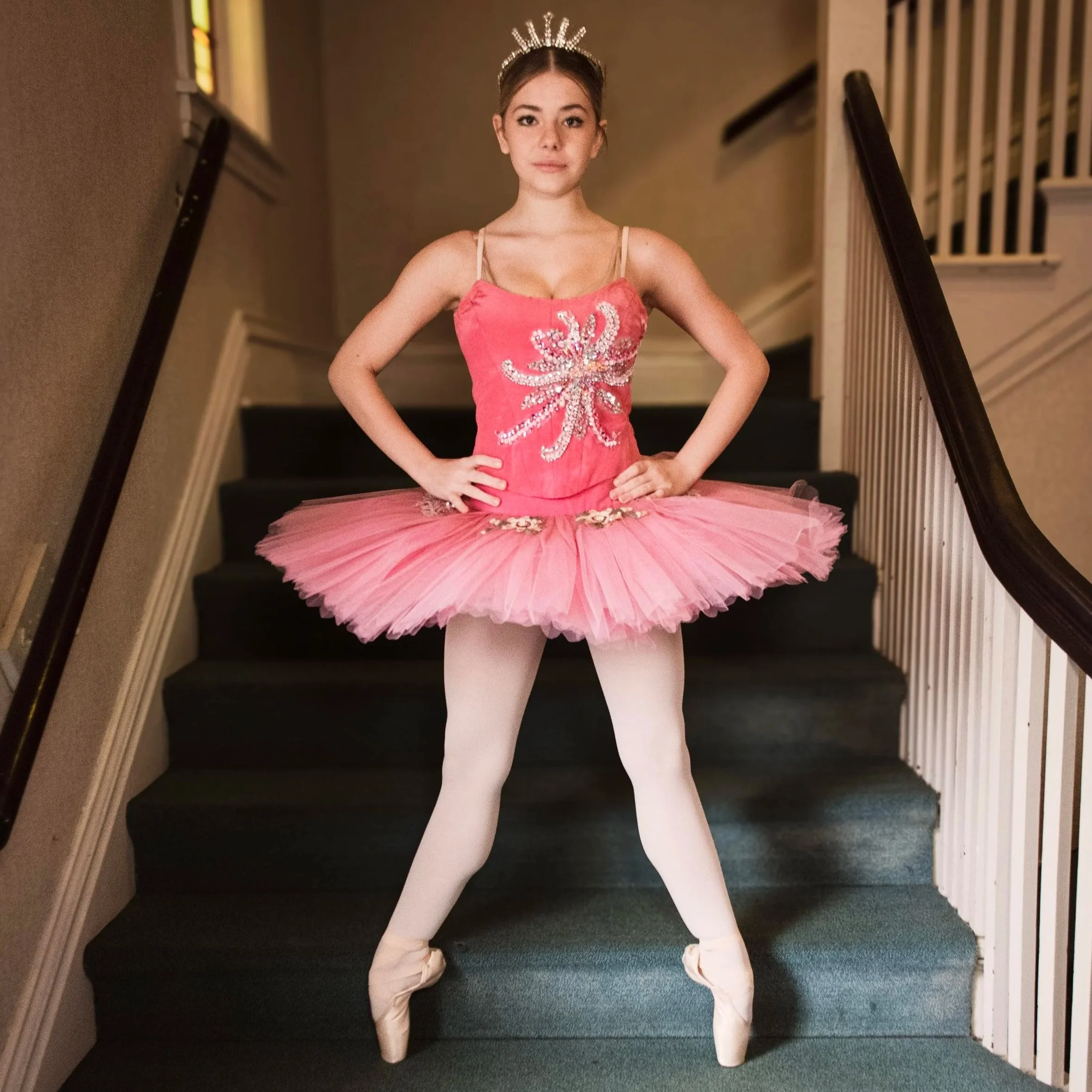
Ballet Levels Should Reflect Readiness, Not Just Age
Age is one factor in ballet placement, but it should not be the only one.
Two dancers of the same age may have very different training histories, physical development, coordination, strength, musical understanding, and technical needs. Placing students solely according to birth year can leave some dancers overwhelmed while others remain insufficiently challenged.
Thoughtful placement considers the whole dancer.
A well-designed ballet program should have a clear progression from foundational training through intermediate and advanced work. Students should develop alignment, coordination, strength, vocabulary, musicality, and movement quality before being asked to perform increasingly complex material.
Advancement should not be treated as a reward or a race. It should happen when the next level is the right educational environment for that dancer.
At Tye Chua Dance, placement is based on readiness, training history, technical development, maturity, and the class environment in which we believe a dancer will grow most successfully.
Ask About the Faculty’s Training and Experience
Professional performance experience can be valuable, but being an accomplished dancer and being an effective teacher are not exactly the same skill.
Good teachers understand how to break movement down, identify the source of a technical difficulty, communicate with different kinds of learners, and adapt their approach to the student in front of them. They understand that children, adolescents, adult beginners, returning dancers, and advanced students require different kinds of instruction.
Look for a faculty with meaningful training, teaching experience, professional perspective, and a shared understanding of the school’s curriculum.
It is also worth asking whether teachers communicate with one another about student development. In a cohesive program, dancers should not feel as though they are entering an entirely different educational system every time the instructor changes.
A strong faculty may include teachers with different backgrounds and artistic perspectives, but the overall progression should remain intentional and consistent.
Safe Training Is Progressive Training
In ballet, more difficult does not always mean more advanced—and faster does not always mean better.
Students need time to develop the strength, coordination, alignment, and movement patterns required for increasingly demanding work. Introducing difficult steps before the underlying foundation is secure can encourage compensation, create persistent technical habits, and place unnecessary stress on a developing body.
Safe progression means that students are taught not only what to do, but how and why.
Teachers should pay attention to:
Alignment through the feet, knees, hips, spine, and shoulders
The gradual development of turnout
Core and pelvic stability
Strength through the feet and ankles
Balanced flexibility and control
Appropriate use of repetition
Fatigue and changes in movement quality
The individual dancer’s physical development
Good training does not mean that dancers are never challenged. It means that challenges are introduced with purpose and preparation.
Pointe Work Should Never Be Rushed
Receiving pointe shoes is an exciting milestone, but pointe work is not simply the next class a student takes after reaching a certain birthday.
A dancer must have sufficient technical training, strength, alignment, control, maturity, and class consistency before beginning pointe. Age matters because the body is still developing, but age alone does not determine readiness.
Before beginning pointe, a dancer should demonstrate the ability to maintain alignment and turnout, control the supporting leg, articulate through the feet, stabilize the ankles, and execute foundational ballet movements consistently without relying on the shoes for support.
Families should be cautious of programs that guarantee pointe placement at a particular age or treat pointe shoes primarily as a symbol of status.
A responsible school should have clear pointe-readiness standards and should be willing to explain them. Saying “not yet” is not a failure. Sometimes it is the most responsible and supportive decision a teacher can make.
At Tye Chua Dance, dancers are not evaluated for pointe before age 12, and readiness is based on individual strength, technique, physical development, training frequency, and consistency.
Pay Attention to the Studio Environment
The physical space matters.
Ballet involves repeated jumping, landing, turning, and weight-bearing activity. A properly constructed sprung floor helps absorb impact and reduces the strain transferred back through the dancer’s joints and body. Marley or another appropriate dance surface should be installed over a suitable subfloor - not placed directly over concrete.
The studio should also provide adequate space, secure barres, clear sightlines, appropriate lighting, and an environment in which dancers can move safely.
Parents should feel comfortable asking what kind of flooring a school uses. This is not an overly technical question. It is a basic question about the environment in which a dancer will train for hundreds or even thousands of hours.
Observe How Corrections Are Given
Corrections are an essential part of ballet training. Dancers cannot progress through praise alone.
However, corrections should be specific, constructive, and appropriate to the student’s age and level. A good teacher helps the dancer understand what needs to change and gives them a practical way to work toward it.
The atmosphere should be focused without being fearful.
Students should be able to make mistakes, ask questions, attempt difficult material, and receive honest feedback without humiliation. High standards and kindness are not opposites. In fact, the strongest teaching often requires both.
A warm environment does not mean that everything is casual or that expectations disappear. It means students know they are respected while being asked to do serious work.
Consider the Role of Performance
Performance is an important part of dance education. It teaches musicality, artistry, preparation, collaboration, resilience, and the ability to communicate with an audience.
But performance should support training rather than replace it.
Ask how casting decisions are made, whether students continue taking regular classes during rehearsal periods, and whether the choreography is suited to their technical level. Performance opportunities should help dancers grow without asking them to repeatedly execute movement they are not prepared to perform safely.
It is also worth understanding whether participation is available to a broad range of students or limited to a small, preselected group.
At Tye Chua Dance, company participation is open to dancers who want to perform. We do not hold auditions for company membership. Auditions are held for individual roles within each production, allowing casting to reflect the needs of the work while preserving access to meaningful performance opportunities.
Look for a Program That Can Grow With the Dancer
A young child’s first ballet class should be joyful, imaginative, and developmentally appropriate. An advanced student needs greater technical detail, training frequency, physical preparation, artistic coaching, and performance experience.
A strong school should be able to support both.
Families may want to ask:
Are there clearly defined levels?
Is there a pathway into more serious training?
Are students able to increase class frequency as they progress?
Is pointe instruction available when appropriate?
Are advanced and pre-professional students challenged?
Are there meaningful options for adults and returning dancers?
Can students perform without being forced onto a professional track?
Not every student wants the same relationship with dance. Some hope to pursue collegiate or professional opportunities. Others want to train seriously because they love the discipline and artistry. Some want a creative home, a physical practice, or a place to return after years away.
A good school should take each of those goals seriously.
Trust What You See and What You Feel
A school’s philosophy should be visible in the everyday experience—not only in its marketing.
When you visit, notice whether students appear engaged and attentive. Listen to the way teachers speak to them. Observe whether the class has structure, whether corrections are meaningful, and whether the movement seems appropriate to the dancers’ level.
Ask questions. A responsible school should be able to explain its placement decisions, training expectations, pointe policies, faculty background, flooring, and performance structure clearly.
You should not feel pressured to understand everything immediately. Ballet is a specialized field, and a good school will help families understand the process.
Serious Training and Genuine Belonging
At Tye Chua Dance, we believe dancers deserve both excellent training and a place where they are genuinely known.
Our program is built around strong classical foundations, thoughtful progression, individual attention, artistic development, and meaningful performance opportunities. We welcome children, teens, and adults—from complete beginners to experienced and pre-professional dancers.
We take ballet seriously. We also believe that serious training should never require a dancer to surrender their curiosity, individuality, or sense of belonging.
The right ballet school is not simply the one with the most impressive presentation. It is the one that can explain how it teaches, why it makes the choices it makes, and how those choices serve the dancer.
Serious Training. Genuine Belonging.
Find the right place for your dancer to grow.
Tye Chua Dance offers thoughtful ballet and dance training in downtown Kalamazoo for children, teens, and adults—from first classes through advanced and pre-professional study.